Artistic + Pedagogical Experiment Project Presentation (November 16, 2025)
For information about the premiere on December 6th, 2025 including the dance participants: https://theatreanddance.wayne.edu/companyone
Background
Winter/Spring 2025
My primary Artistic Experiment in Artistic Praxis 1 was a study of HIV and its influences on my somatic, living system while undergoing life-saving Antiretroviral Therapy (ART). It was a solo figurative project in which I processed my recent diagnosis of HIV and its implicit and explicit stigmas, its local concerns, and its medical misconceptions. The solo experiment was a relatively abject auto-ethnography that illuminated an inner monologue of science-based and movement research that helped me reckon with my new body and its sociopolitical implications and historicized up-pinnings. It resulted in multimedia clusters of gay-male hagiography, educational constructivism, and biological cybernetics. Cluster 1: Hagiography is included below. For Cluster 2-5, please contact me at samuel.horning@wayne.edu.
Today with life-saving ART almost all strains of HIV are easier to treat than high-blood pressure. Emotional and financial costs remain.
Turn from Praxis I to Praxis II
Summer, 2025
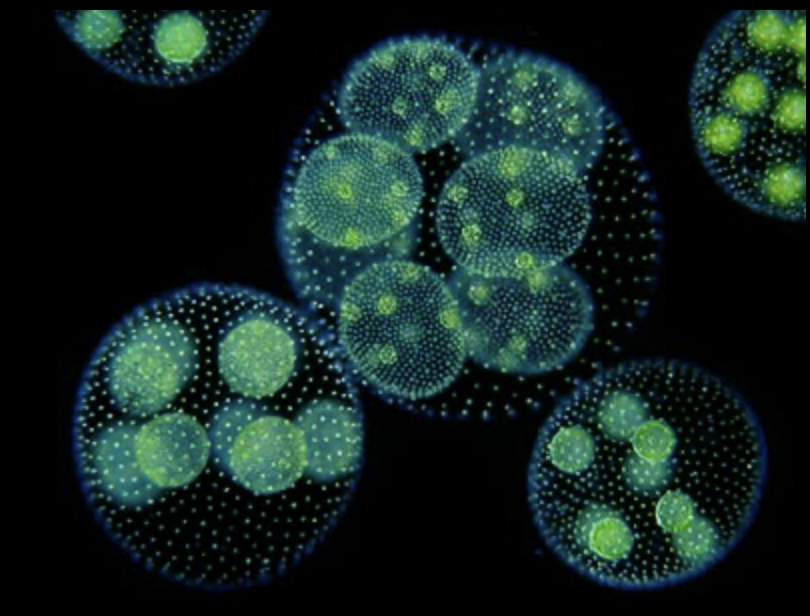
Auto-ethnography in/aside, I began to explore the natural world outside of the context of my HIV diagnosis through observation and question-asking. A teacher at the school I work at, Hunter Jones, introduced me to the Volvox Algae and the question that has immense interest to microbiologists: How did single celled life become multicellular? I realized that the question itself is derived from scientific inquiry, and, it offers such a vibrant metaphor for community organizing through somatically inclusive dance. As a high school biology teacher, I knew nothing about this topic and began researching rote knowledge online. For instance: the volvox algae retains its individuality yet together can survive predation, has enhanced mobility, and includes division of labor for survivability. Although fictive, I began to envision the dancers arriving at conclusions about multicellularity for themselves and to explore the topic as a place of departure. I also envisioned the dancers and my choreography assisting a scientist in arriving at new knowledge about the origins of multicellular behavior. How could I guide the dancers there? And the scientist? What questions would I ask? What choreography would I make? What discoveries could be made?
Concept Statement to the Company One Participants
September 1, 2025
How did single celled life become multicellular? This question is one of immense discovery and mystery in the biological sciences and can teach us about our humanity. The volvox algae (also known as the globe algae) contains many lessons about the origins of colonial life in which cells that stayed together were better suited to survive the natural world. Each cell in a volvox retains its individuality yet together the volvox can survive predation, has enhanced mobility, can phototaxize by creating specialized light-sensing eyespots, and has improved nutrient uptake. An important advantage includes division of labor for survivability. Like the volvox algae, you are coming together with your peers in Company One from different dancing practices and experiences. Each of you has variability in your movement style and artistic interests. You have decided to seriously pursue dance as a career and one of my goals is to help you build your own individuality as well as a group communality. Together, we’ll be creating a piece I am currently calling Volvox and Other Colonies which is designed for you to explore and demonstrate cooperative movement learning. Cooperation requires both leadership and followship skillsets and an ability to use your efforts for the betterment of the group. My hope is that you will bring your fullest selves to each stage of this process. When you bring your fullest self, the entire community will be augmented in movement nature. Throughout this process, you’ll work alone in your personal movement laboratory to create material for the group. You’ll also work with partners to develop shared ratcheting movements. During my residency, I’ll use the process of mereology to bring the parts together into a unified whole.
Design Plan
September 1, 2025
Participant Learning Outcomes
September 13, 2025
Age: Post-Secondary Dance Students
Participants will be able to… (PWBAT…)
A) PWBAT create, recall, and perform movements created from their interpretations of the processes of multicellularity.
B) PWBAT apply cooperative learning strategies in the creation of ensemble movement material based on colonial organisms, swarms/bacterial wolf packs, and flocks.
C) PWBAT understand and apply movement patterns based on individual, facultative, and obligate multicellularities.
D) PWBAT identify actionable phrases and interpret movement material from lectures about matter and energy.
E) PWBAT engage audiences in collective movement making through flocking, collective phylogenies, and combined behavioral traits.
F) PWBAT design, evaluate, and refine a collective solution for reducing the impacts of human activities on the environment and biodiversity.
Teaching Session Grid (8 Lessons: Distance Learning)
September 13, 2025
5th Revision: November 16, 2025
Rehearsals began through distance learning. I provided movement assignments for the twelve Company One dancers which were facilitated by Prof. Lisa Wilmot through in-person rehearsals once weekly from September 10 through my arrival to Wayne State University on October 8 as a guest artist. My session grid was planned for the online component of the process.
There were two primary clusters of the distance component of my A+PE. The first cluster was a shared movement alphabet between the dancers in which the student-artists coordinated movements created from an “energy in cells” lecture to letters of the English alphabet. They could then use the alphabet to spell words. The goal of this activity was to facilitate a process of individualizing the dancers by breaking apart their creative movements into small pieces and have them reordered.
The second cluster involved assigning each student-artist a scientist to research and include as a part of the movement creation in their solo. Each student artist created a solo.
In-Person Residency (4 Days)
The in-person residency centralized around a visit from Dr. Penelope Higgs from the Department of Biological Science at Wayne State University. Please see the traces of the residency below:
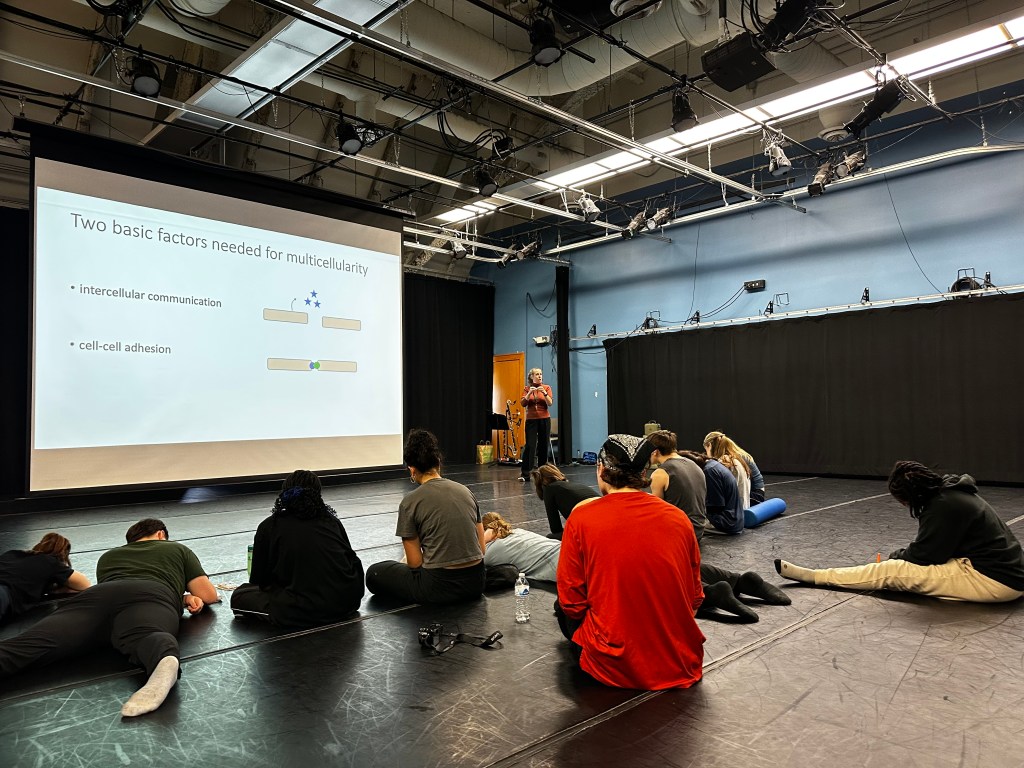
Follow the lecture/demonstration from Dr. Penelope Higgs, the piece turned toward the M. Xanthus Bacteria. Dr. Higgs provided a score for the dancers which is the central component of the choreography. Her score:
“Could you start with dancers with random movements (reversals that are not coordinated) that gradually organize into the organized waves necessary for predation (rippling)? Kind of the evolution of cooperation? Then switch to biofilm formation with groups of dancers moving together to form a fruiting body mound – dancers each transition into a spore (curl up) to form a fruiting body. And some dancers remaining on the outsides of the fruiting bodies? Then a movement whether they could all germinate into a productive feeding colony again??”
A graduate student at WSU, Cameron Page, was invited to join the process as a musician. He created individualized music compositions for each dancers which he later layered into three underscores.
I extracted videos found online of topics relevant to the choreography and sequenced them through projections which will occur upstage of dancers on the cyclorama or a scrim. The questions found in the projections are sourced from the Michigan Dance Standards and from the students.
To view a rehearsal of the dance (without projections and current music) please click this link : Oct 15_run of dance.MOV
Or this link: Final Run.MOV from October 12th.
For the theoretical underpinnings of the in-person processes, please contact Sam Horning at Samuel.horning@wayne.edu for a discussion. Some relevant writing from my graduate studies include the Hybrid Lives of Teaching Artistry in Dance & Theatre Arts: A Critical Reader; and Nachmanovitch, Stephen. Free Play: Improvisation in Life and Art.
Business Plan
Slime Mold Intelligence(s)
What do I teach?
I teach inquiry-driven science and dance curricula resulting in performances and educative engagements. The curricula include individualized lesson objectives, interdisciplinary collaborations, and outputs that have meaning and relevance to the learner. The curricula is developed with the learner in which they are an active participant in constructing their knowledge.
My current curriculum is called Slime Mold Intelligence(s) This project explores the nuanced signaling pathways that produce colonial living, cooperative aggregation, and division of labor. The curriculum involves self-driven and process-based understandings of the mechanisms which drive multicellularity between reproductive (germ) and non-reproductive (somatic) cells through asymmetrical divisions.
I am a Teaching Artist Educator which means that my focus is on the instruction and cultivation of artistry in learners. Universal, individuated, and experimental conditions are included in my curriculum. Through inquiry-based instruction, learners create their own understandings of the phenomena.
Why do I teach this curriculum?
Artistry emerges from the essence of the artist and is informed by their lived experiences, understanding of the observable universe and the world in motion, and the meaning and relevance they conclude. P-12 science educators have strived to create curricula this is three dimensional, cooperative, and ensures the learner interprets their own data. A gap persists between a textual or written understanding of science and practical applications, all of which inform an artists range to create movements of natural alignment.
What students will benefit from this program of study?
This program of study is designed for first and second year students in higher education dance programs. My curriculum is a bridge between the requirements of standardized scientific study in P-12 schools and the comparatively open standards (in some cases, the absence of standards) of dance in higher education. These students, and their guiding professors, benefit through this curriculum by making scientific proficiency embodied as a way to enhance the personal artistry of dance students through critical pedagogy.
Why should a university bring me as a Teaching Artist Educator?
My curricula is built from my experiences as an educator, researcher, administrator, choreographer, and dancer. My lessons include tools, practices, and strategies I have accumulated over my years. These include strategies for community-organizing, developing research strata, individuating learning through movement, interdisciplinary study, and personal artistry. My curricula develops alongside each institution and is guided by the goals defined by the lead professors. Each engagement contributes to the larger understanding and archive of Slime Mold Intelligence(s).
What is my timeline to bring this curriculum into fruition?
I am aiming for one guest artist residency in the following semesters: Fall of 2026, Winter of 2027, Fall of 2027, Winter of 2028. In total, five guest artist residencies beginning in Fall of 2025 with Wayne State Universities Touring Company One will allow me to bring into fruition vessels of my project. Each of these residencies will allow me to make deliverable and cogent the project respective of each community. For the years 2028-2030, I will be seeking partner organizations outside of higher education for my curriculum and its components to be more widely shared including conferences, festivals, performances in theaters, and symposiums about education in both science and dance.
 Samuel Horning